Peak-a-boo: Making Binary Chromatographic Peak Detections Reviewable
Saurav Ghosh (Washington University in St. Louis), Saugat Pandey (Furman University), Alvitta Ottley (Washington University in St. Louis)

Links
Sign in to access the Paper PDF.
Abstract
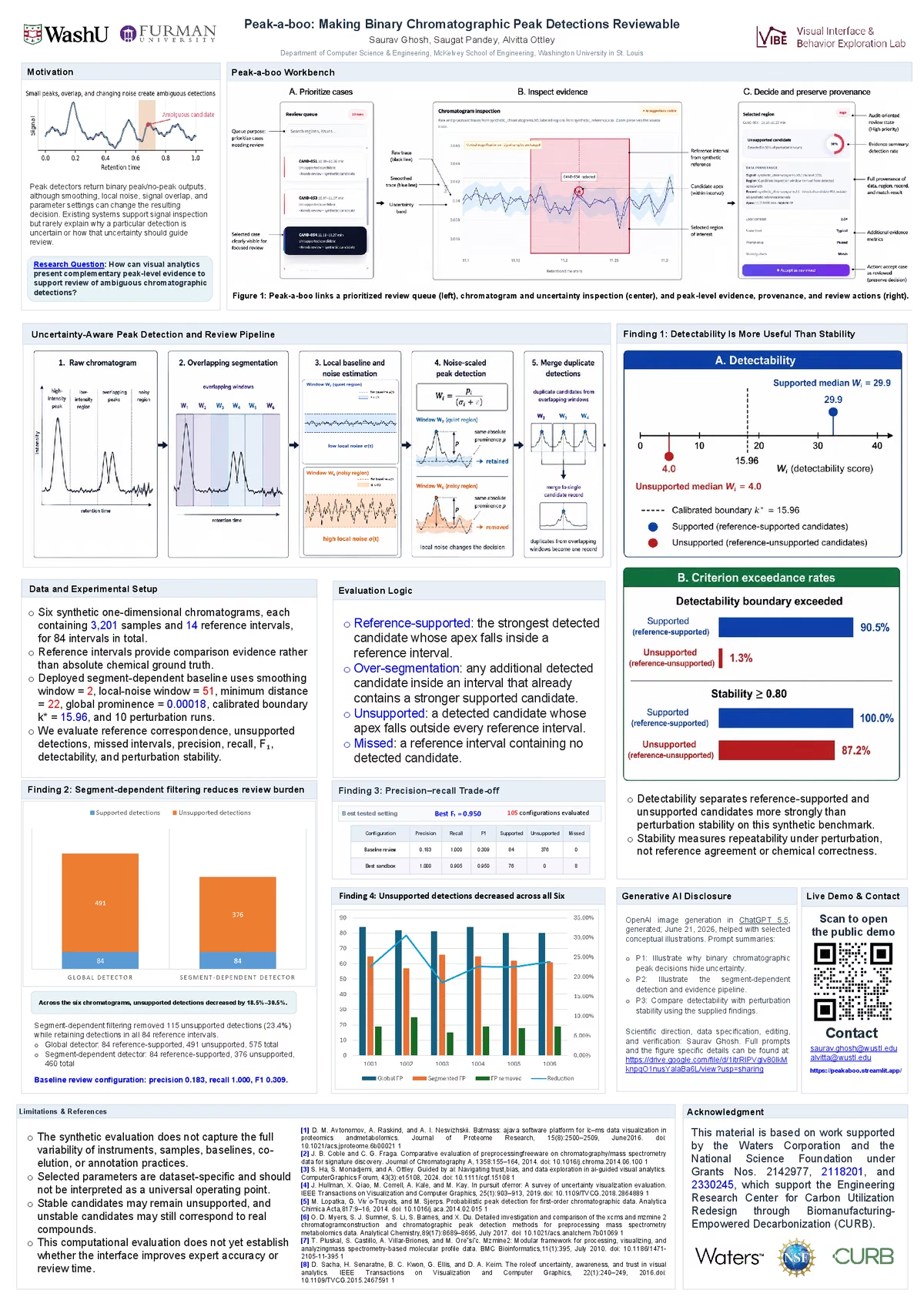
Chromatographic peak detectors return binary decisions, even though smoothing, local noise, signal overlap, and parameter choices can affect the outcomes. This sensitivity complicates interpretation and may encourage over-reliance on automation. We present Peak-a-boo, an uncertainty-aware visual analytics workbench that combines segment-dependent detection with evidence for detectability, perturbation stability, reference correspondence, and provenance in a review and audit workflow. On six synthetic chromatograms with 84 reference intervals, segment-dependent filtering removed 23.4% of unsupported detections while retaining all supported peaks. Across 105 parameter configurations, the best setting achieved F₁ = 0.950, and detectability separated supported from unsupported candidates more clearly than stability. Peak-a-boo demonstrates how complementary algorithmic evidence can support the review of uncertain scientific detections.